Something that I noticed, today, about HR

gwinegarden

Member
Jul 20, 2013
823
0
16
Went to the gym to do some cardio, today. I started on the bike and noticed that my HR went nuts. It was showing 160-170. After a couple of minutes, I took my hands off the handlebars and the rate slowly came down to the real world. I put my hands back on the bar, as before, and up my HR went. So I consciously began using a looser grip and changing hand positions and the rate stayed down.

I, then, went onto an elliptical machine and the same thing happened when I gripped the handles tightly.

So, I am wondering if pressure on some areas of my palms cause some kind of problem for the band reading my pulse so near the spot. Possibly blood flow is being altered in that area.

Just wanted to throw that out.
 
Good observations and most probably grip and blood flow may have some effect on HR sensor.

Posted via the Windows Central App for Android
 
I haven't noticed anything unusual while rowing on the erg. Not sure why it would do that. Do the handles have the areas to grip so the machine will show your heart rate? Maybe there's some sort of EM interference from that.
 
Well, this is exactly what I experience with stationary cycling. For me though, taking my hands off the handlebars doesn't change it, so I don't really think gripping the bars is significant. Besides, when on the trainer, I rarely actually grip the bars unless I'm grinding out strength intervals. Otherwise I'm more just resting my hands on the bars. If I just keep going, after about 10 minutes, it'll settle down, which is of course, not really acceptable. What I'm doing now is to stop peddling, and wait for what seems like an eternity (but is in reality probably more like 30 seconds or so), and suddenly hr will rapidly drop down to normal. Sometimes I have to do this two or three times before it stops rapidly rising to an abnormal peak, but then its fine.

Due to the weather, I haven't been able to see how it does on outdoor cycling, or much of anything outdoors for that matter. I know it hasn't done this on the treadmill, or doing strength training, only stationary biking. Anecdotaly, I also use a Garmin hr strap, a Cycle-ops heart rate strap, a Mio Fuse optical hr, and a Schosche Rhythm + optical hr monitor (Not all at the same time!). None of these other monitors displays this behavior; nor did my Band 1 for that matter, just the Band 2.

Another possible theory is that the Band is confused by a rising heart rate that isn't combined with any sort of arm/body movement. On the trainer, everything is pretty still (ideally) except your legs, and pedaling motion isn't really seen by the accelerometer (which is a good thing, since it would whack out your step count). I don't know, but it certainly is odd.
 
Hi guys, I have a Polar HR monitor watch and have compared it to the Band 2, Mio Fuse, Peak Fitness and now the Fitbit Surge. No optical monitor can keep pace with the dedicated chest strap device. When you do pushups or pullups, none of the devices register the high HR and you have to stop moving and watch the devices catch up with the HR displayed on the Polar. Sometimes I have the optical devices showing 80 BPM when I am at 130 say and they only match at around 110 BPM when I am stationery in recovery.
So yes, muscle use certainly distorts the readout of these optical devices. Don't expect any optical HR device to be accurate when you are doing exercise with the arm that the device is on.
 
When I exercise I wear a MIO Link paired with the iPhone Digitfit app and my Band 2. I find that on the NorticTrack Ski machine my Band 2 hr is sky high and never settles down. On the rowing machine with the Band 2 rowing tile, the treadmill with the run tile and biking with the bike tile the Link and Band 2 are almost always within 2 or 3 beats. I wear both on the left arm. I find that with the Band 2 placed above the Link as high on the arm as possible I get the best results.
 
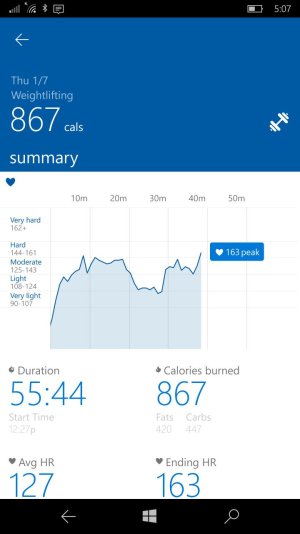
wp_ss_20160108_0001.jpg

Yesterday I did some light lifting and abs work and ended it all off with rowing ergo for 15 mins. Band did well on the weightlifting mode exactly until I started the rowing. The heartrate monitoring ends at 39 minutes until the whole rowing session (I didn't stop the weightlifting mode and start anew with rowing mode on). Now, if someone can explain that...
 
I am also seeing odd spikes and drops in my HR while exercising (but it seems fine when I run). The most concerning part is that, like Nate Silver noted, it's a problem with Band 2 that I never saw with Band 1. This causes me to think (hope?) that it's software-related and can be fixed with an update.
 
In my experimentation with Band 1, I found that placement could have a dramatic effect on results. The best spot I found was with it cocked at a strange angle. (Neither top nor bottom, but cocked at a 45 degree angle.) Since the HR sensor is in a different place on the 2, it's not surprise it could give different results.
 
My understanding is the Band measures heart rate by micro movements on the surface of the skin. HR detection might work better if you wear it face down because the pulse is stronger on the bottom of the wrist.
 
My understanding is the Band measures heart rate by micro movements on the surface of the skin. HR detection might work better if you wear it face down because the pulse is stronger on the bottom of the wrist.

Not movement, but more by the change in how light goes though the skin. I assume it's the capillaries swelling with the heart beat. Supposedly the top side is better. That big vein doesn't work so well. It needs capillaries. I think the trick is finding a cooperative group of them. Too bad the Band doesn't have a "signal strength" or "signal quality" meter for the HR.
 
Not movement, but more by the change in how light goes though the skin. I assume it's the capillaries swelling with the heart beat. Supposedly the top side is better. That big vein doesn't work so well. It needs capillaries. I think the trick is finding a cooperative group of them. Too bad the Band doesn't have a "signal strength" or "signal quality" meter for the HR.

Right, capillary action is what it is measuring, as interpreted by the software. And typically, the top side of the wrist is said to be preferable to the 'vein' side. However, with Band 2, I've had less luck with the top side than I have with the bottom side.

What I'd really like to be able to understand is why it misreads so badly at the beginning of my spinning workouts, yet is otherwise quite accurate. As I've said before, it typically takes about 10 minutes, give or take, for things to settle down and read correctly. During that initial period when it is spiking, I can even take the Band off, and watch the hr continue to climb rapidly, say from 120 bpm to 150 or more, until suddenly it will stop and fall back. When I put it back on, sometimes it will spike again, but usually will settle into something more accurate. Perhaps the software is looking for active arm or body movement from the accelerometer when the user initiates a workout. It sees the heart rate begin to increase, and it doesn't get what it sees as the appropriate level of body movement, so the software gets confused.Might not be that at all, but optical hr measurement is quite dependent on software interpretation of what the sensor is 'seeing', which makes me think that software is the culprit here. Otherwise, I can think of no logical reason why the readings would otherwise be quite accurate, with the exception of this circumstance.

Perhaps @devbent has some contacts on the sensor side of the house that can help out with this??
 
During that initial period when it is spiking, I can even take the Band off, and watch the hr continue to climb rapidly, say from 120 bpm to 150 or more, until suddenly it will stop and fall back.
Interesting.

Personally, I think motion, particularly arm motion, is an issue. Sure, heartbeats cause the capillaries to change, but I'd imagine that flexing your arm does something was well. I'd think the Band would be using the accelerometer to try and subtract motion from the raw sensor readings - but it may not be all that successful in doing that. The spike could be the HR + motion. Once it figures things out (if it does), then it settles down. Taking it off forces an analysis "reset".

Still, if we could get a reading on the quality of the HR signal, we could probably figure out how to deal with it.
 
Not movement, but more by the change in how light goes though the skin. I assume it's the capillaries swelling with the heart beat. Supposedly the top side is better. That big vein doesn't work so well. It needs capillaries. I think the trick is finding a cooperative group of them. Too bad the Band doesn't have a "signal strength" or "signal quality" meter for the HR.

Oh ok, good to know, thanks.
 
Right, capillary action is what it is measuring, as interpreted by the software. And typically, the top side of the wrist is said to be preferable to the 'vein' side. However, with Band 2, I've had less luck with the top side than I have with the bottom side.

I believe that Microsoft recommends the inside of the wrist orientation for the Band 2, and I have to assume that the optical HR monitor was designed to perform best when worn the suggested way.
 
I believe that Microsoft recommends the inside of the wrist orientation for the Band 2, and I have to assume that the optical HR monitor was designed to perform best when worn the suggested way.
I've not seen any suggestion for 2. The ads seem to show it both ways.
 
Well, my band lost its mind, completely, today. I went on the stationary bike and within 2 minutes, it said my HR was 160. It then kept going up. I was taking my actual pulse, in my neck to compare. Actual rate 90, band rate 181 (I would be dead). But the real problem is it never settled down for more than a few seconds. Previously, it would return to reality after a few minutes.

Then I went onto the treadmill to for a while. Again, it went insane, this time even stranger. My rate would be 160, then, a few seconds later, 90. It only stayed near real values for about 2 minutes out of 33. According to the band, my average HR was 130 where, in reality, it never got above 110.

And to add to my grief, it stopped receiving notifications today, received one this morning then nothing.

I've tried a quick reset (2 button method) to see if this helps. If not, I will do a full reset to factory settings. But, unfortunately, if this continues, it will have to go back.
 
I find the HR reading is only occasionally accurate. It bounces all over the place and intermittently settles on the right number. I don't know if it is just my unit or an inherent flaw.
 
I believe it to be a real problem, but whether its systemic or just a few examples, I don't know. I keep hoping it is software and not the sensor itself, and keep hoping to hear of a firmware update to address it. Doesn't have me ready to return it (just yet), since the Band is not the only way I track my activities, but it is disturbing. My primary focus is cycling, and it being winter, particularly stationary cycling for the next three months or so. Haven't been able to test it on the road, but evidently stationary cycling is one activity that really throws it for a loop.
 
I don't want to return it as I do like it, but, if the HR is going to be that far off, in the future, it really decreases its value for me.
 

Trending Posts

Forum statistics

Threads
343,238
Messages
2,266,319
Members
428,900
Latest member
YeOldRam