
Windows Phone at 2.6% in August 2015
- Thread starter luxnws
- Start date
You are using an out of date browser. It may not display this or other websites correctly.
You should upgrade or use an alternative browser.
You should upgrade or use an alternative browser.

theefman
Active member
- Nov 14, 2008
- 3,979
- 5
- 38
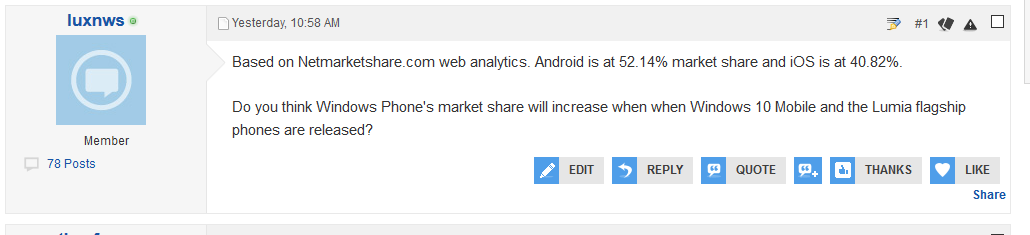
Do you think Windows Phone's market share will increase when when Windows 10 Mobile and the Lumia flagship phones are released?
Nope. Don't see anything in W10M that will appeal to anyone other than current users of WP devices

RumoredNow
New member
- Nov 12, 2012
- 18,134
- 1
- 0
Android is at 52.14% market share and iOS is at 40.82%
Of what? Global? US? Selected Markets?
Johnny Tremaine
Member
- Apr 6, 2012
- 224
- 0
- 16
Those iOS numbers looks like U.S. domestic, but the Windows phone numbers are pretty similar to the global share, at between 2.5-3%.
And to answer the OP's question: No, I think those numbers will stay the same; the WP faithful will mostly buy up the new devices but I can't see what would appeal to users of other platforms to switch. Continuum is a nice talking point for enterprise IT admin buyers, but that's about it.
And to answer the OP's question: No, I think those numbers will stay the same; the WP faithful will mostly buy up the new devices but I can't see what would appeal to users of other platforms to switch. Continuum is a nice talking point for enterprise IT admin buyers, but that's about it.
RumoredNow
New member
- Nov 12, 2012
- 18,134
- 1
- 0
Those iOS numbers looks like U.S. domestic, but the Windows phone numbers are pretty similar to the global share, at between 2.5-3%.
When I see such things in the forum I'm dubious because the OP rarely includes enough detail... Even with a link I want to check the source and methodology. In college I spent some time learning how to analyze statistical and scientific reporting in the media. Most of it is... just a waste of time.
Interesting reply.
The forum moderator questions the methodology of Netmarketshare for mobile/tablet market share while Windows Central (and many other blogs) used the same source for the Windows 10 August 2015 market share articles posted today.
Windows 10 captures 5.21% of the worldwide PC OS market share in August | Windows Central
That distinction rates an article in and of itself, yes?
The forum moderator questions the methodology of Netmarketshare for mobile/tablet market share while Windows Central (and many other blogs) used the same source for the Windows 10 August 2015 market share articles posted today.
Windows 10 captures 5.21% of the worldwide PC OS market share in August | Windows Central
That distinction rates an article in and of itself, yes?
Interesting reply.
The forum moderator questions the methodology of Netmarketshare for mobile/tablet market share while Windows Central (and many other blogs) used the same source for the Windows 10 August 2015 market share articles posted today.
Windows 10 captures 5.21% of the worldwide PC OS market share in August | Windows Central
That distinction rates an article in and of itself, yes?
The concept is simple: we embrace any statistic that validates our choice of platform, while downplaying and criticizing any statistic that does anything less than exalt it.

RumoredNow
New member
- Nov 12, 2012
- 18,134
- 1
- 0
Interesting reply.
There was no link, hence, nothing for me to evaluate. Even WC articles get scrutinized by myself for my own consumption.
I was asking for a tag for what stats were being represented (World, US, Select Markets) and someone else replied what they thought it meant.
I like to see the source, that's all. When you plain type a generic website, I would then have to crawl all over it trying to guess exactly which page you were quoting from.
To be fair, most media outlets (WC included) cherry pick stuff and run with it. This is journalism. Statistical analysis and analytic thought applied to media reporting is not unknown to journalists, but I can not say how much or how little gets applied unless I'm looking at the article and the source and spending time doing my own analysis. This is why journalists quote the source they drew from, or should.
My remarks on the OP were to ask for a tag to define the values stated.
My further remarks about withholding judgement of validity were in response to reader supposition, again without specific source. Taking reports of stats blindly as valid is a habit I try not to fall into.
I'm not impugning you, luxnws. All I wanted was to know percentage of what?
98% of all statistics are made up. ~Author Unknown
Read my comment to the Sept. 1, 2015 Window Central article on Windows 10 market share. My comment includes the link to the Netmarketshare data for the Windows Phone market share in August 2015. You can even see the 5.21% number posted by Windows Central for Windows 10 in the Netmarketshare site. It's why I posted the link in my comment in this thread.
No slight intended but fwiw you probably would have spent less time reading the Windows Central article and comments than you spent on writing your latest formatted reply in this thread.
No slight intended but fwiw you probably would have spent less time reading the Windows Central article and comments than you spent on writing your latest formatted reply in this thread.

mark233
New member
- Dec 26, 2013
- 1,118
- 0
- 0
RumoredNow
New member
- Nov 12, 2012
- 18,134
- 1
- 0
I'm sorry. I'm not seeing a link. Not a hot-link.I see a web address that has to be copied and pasted. That takes me to a webpage that shows me all kinds of stuff I have to crawl through.
My original question was: % of what??? You never defined it. You simply said.

"Android is 52.14% market share and iOS is at 40.82%"
But of what? There are no labels. You never pointed to an article.
I'm not saying the numbers are not right, were not reported, are fabricated...
You want a discussion on something, but I don't know what you want to discuss. The OP is not clearly defined on what the subject is about...
If there was an article and a comment from you following the article; this thread gives no clue to that. I'm just finding out now that you have a comment out there that sheds valuable light on what it is you want to discuss. I apologize as I'm not Following all of your posts and comments so I had no idea of the history of the discussion. I mistakenly thought I was coming in at the beginning rather than the middle.
So here is the article: Windows 10 captures 5.21% of the worldwide PC OS market share in August | Windows Central It isn't about Windows Phones at all. Still I guess I should have known to look for it.
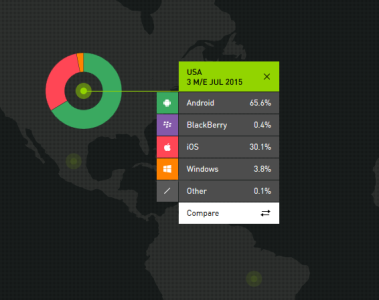
Here's your comment under the article, I scrolled down and found it:

That's where the link went to. I'm sorry. I guess you did post a link after all.
So that is helpful. Now I can see some tags to the data...

I see it appears to probably represent a global sample, even though it does not explicitly state that. And it appears to be only for the month of August as a snap shot.
I also note that Mobile and Tablet are lumped together.
That tells me it is under-reporting Windows as iOS and Android tablets and phones get lumped together and Windows tablets most likely report elsewhere under Desktop and RT. Unfair advantage iOS & Android in their reporting methodology.
Cool. Thanks for helping me find out what we are talking about here.
So back to your original question... No. Not with that methodology I don't.
My original question was: % of what??? You never defined it. You simply said.
"Android is 52.14% market share and iOS is at 40.82%"
But of what? There are no labels. You never pointed to an article.
I'm not saying the numbers are not right, were not reported, are fabricated...
You want a discussion on something, but I don't know what you want to discuss. The OP is not clearly defined on what the subject is about...
If there was an article and a comment from you following the article; this thread gives no clue to that. I'm just finding out now that you have a comment out there that sheds valuable light on what it is you want to discuss. I apologize as I'm not Following all of your posts and comments so I had no idea of the history of the discussion. I mistakenly thought I was coming in at the beginning rather than the middle.
So here is the article: Windows 10 captures 5.21% of the worldwide PC OS market share in August | Windows Central It isn't about Windows Phones at all. Still I guess I should have known to look for it.
Here's your comment under the article, I scrolled down and found it:
That's where the link went to. I'm sorry. I guess you did post a link after all.
So that is helpful. Now I can see some tags to the data...
I see it appears to probably represent a global sample, even though it does not explicitly state that. And it appears to be only for the month of August as a snap shot.
I also note that Mobile and Tablet are lumped together.
That tells me it is under-reporting Windows as iOS and Android tablets and phones get lumped together and Windows tablets most likely report elsewhere under Desktop and RT. Unfair advantage iOS & Android in their reporting methodology.
Cool. Thanks for helping me find out what we are talking about here.
So back to your original question... No. Not with that methodology I don't.
Attachments

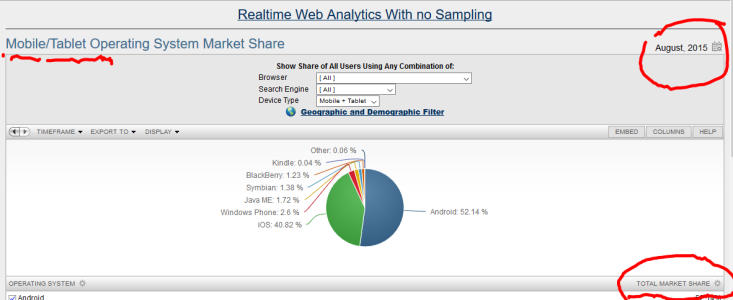
The original question was will Windows Phone market share increase from the 2.6%, well 2.60% to be exact based on the Netmarketshare data after Win 10 Mobile and the flagships are released.
Won't features like universal apps and Continuum drive market share? Even if mobile/tablet data is combined, the forum think in this thread appears to be that Windows Phone market share won't grow larger than 2.6%? Coming from Windows Phone enthusiasts, that is telling.
Won't features like universal apps and Continuum drive market share? Even if mobile/tablet data is combined, the forum think in this thread appears to be that Windows Phone market share won't grow larger than 2.6%? Coming from Windows Phone enthusiasts, that is telling.
RumoredNow
New member
- Nov 12, 2012
- 18,134
- 1
- 0
Sales and use of other devices aren't going to halt. Looking at the stats gathered I see a major flaw... And most stat gatherers fall into the same error.
Android on phone and Android on tablet are lumped together as Mobile. Same with iPhone and iPad. Stat hounds collect Mobile, yet ignore a Windows based tablet. It runs desktop, but you can carry that son of a gun around just as easy as a Galaxy Tab or iPad.
They don't know how to track the metric.
So Apple gets a double dip with the large scooper. Android gets a double dip with the large scooper. Windows gets one small scoop with a table spoon and the tub of portable (thus mobile) Windows devices gets shoved into desktop.
It's hard to counter that double count sustained growth with a trickle of increase.
Having tracked down all parts of your conversation earlier, I fully understand the question you are asking.
Let me ask one. Do you see the flaw in the methodology and how it skews the stats?
Android on phone and Android on tablet are lumped together as Mobile. Same with iPhone and iPad. Stat hounds collect Mobile, yet ignore a Windows based tablet. It runs desktop, but you can carry that son of a gun around just as easy as a Galaxy Tab or iPad.
They don't know how to track the metric.
So Apple gets a double dip with the large scooper. Android gets a double dip with the large scooper. Windows gets one small scoop with a table spoon and the tub of portable (thus mobile) Windows devices gets shoved into desktop.
It's hard to counter that double count sustained growth with a trickle of increase.
Having tracked down all parts of your conversation earlier, I fully understand the question you are asking.
Let me ask one. Do you see the flaw in the methodology and how it skews the stats?
anon(5518418)
New member
- Jan 19, 2013
- 117
- 0
- 0
Sales and use of other devices aren't going to halt. Looking at the stats gathered I see a major flaw... And most stat gatherers fall into the same error.
Android on phone and Android on tablet are lumped together as Mobile. Same with iPhone and iPad. Stat hounds collect Mobile, yet ignore a Windows based tablet. It runs desktop, but you can carry that son of a gun around just as easy as a Galaxy Tab or iPad.
They don't know how to track the metric.
So Apple gets a double dip with the large scooper. Android gets a double dip with the large scooper. Windows gets one small scoop with a table spoon and the tub of portable (thus mobile) Windows devices gets shoved into desktop.
It's hard to counter that double count sustained growth with a trickle of increase.
Having tracked down all parts of your conversation earlier, I fully understand the question you are asking.
Let me ask one. Do you see the flaw in the methodology and how it skews the stats?
Well spotted and great point

@dj1891, you got <word not allowed> by the moderator.
Tablets are expected to have negative growth this year. Anyone who has posted 9k messages on the forums would know that tablet growth is expected to only be in the low to mid single digit range over the next few years. For Apple, tablet growth will probably be a (very slight) drag on the combined rate of growth when mixed with cell phone growth given how well the iPhone 6 has been doing.
Basically in an obtuse way the mod is agreeing that even Windows Phone enthusiasts don't expect much growth in Windows Phone market share after the release of Windows 10 Mobile and the flagships. Honestly I was expecting at least a couple of optimists.
Tablets are expected to have negative growth this year. Anyone who has posted 9k messages on the forums would know that tablet growth is expected to only be in the low to mid single digit range over the next few years. For Apple, tablet growth will probably be a (very slight) drag on the combined rate of growth when mixed with cell phone growth given how well the iPhone 6 has been doing.
Basically in an obtuse way the mod is agreeing that even Windows Phone enthusiasts don't expect much growth in Windows Phone market share after the release of Windows 10 Mobile and the flagships. Honestly I was expecting at least a couple of optimists.
Last edited by a moderator:
RumoredNow
New member
- Nov 12, 2012
- 18,134
- 1
- 0
So it's fair that Windows Phone has to measure against Android Phone + Android Tablet and iOS Phone + iOS Tablet no matter the growth rates?
Put Windows Phones only against Android Phones and iOS Phones and the playing field is level. Progress is easier to track and more relevant for analysis.
Additionally, these are my personal opinions. You calling me, "the mod," is an obfuscation in and of itself. It's just coincidental I have a mod badge, not indicative of anything.
Not necessarily. Assuming facts not in evidence. You are drawing a conclusion from nothing presented thus far....Anyone who has posted 9k messages on the forums would know that...
I'm not agreeing with anything. You are trying to put words in my mouth. I'm simply examining the methodology. Based on the way the metrics record from the source you provided, I see an anomaly that unfairly burdens WP in the analysis that stat gatherer produces....in an obtuse way the mod is agreeing that even Windows Phone enthusiasts don't expect much growth in Windows Phone market share after the release of Windows 10 Mobile...
Put Windows Phones only against Android Phones and iOS Phones and the playing field is level. Progress is easier to track and more relevant for analysis.
Additionally, these are my personal opinions. You calling me, "the mod," is an obfuscation in and of itself. It's just coincidental I have a mod badge, not indicative of anything.
Android on phone and Android on tablet are lumped together as Mobile. Same with iPhone and iPad. Stat hounds collect Mobile, yet ignore a Windows based tablet.
Just to play devil's advocate here, do you know for sure that this is the case? I have no idea. And even if it is, aren't the statistics comparing platforms here? Android vs iOS vs WP/W10M. In that case, technically speaking it is totally valid. But you are correct in that it is not counting just phones if you are correct. However, Android and iOS both run on more than just phones. WP doesn't. Now that RT is out of the picture (other than existing devices), it is either WP/W10M or Windows 10. The tablets should be in the same category as the computers, based on the OS.
When the majority of Microsoft's phones are running W10M, are we going to lump together all Windows 10 devices, including PCs, phones, xBox, and whatever else there is? Now, you know as well as I do that W10 and W10M are not the same; it is more accurate to say that they both run apps that are tweaked to handle both. But the marketing is that it is one OS. It will be interesting to see how that's marketed in a year or two.

a5cent
New member
- Nov 3, 2011
- 6,622
- 0
- 0
Just to play devil's advocate here, do you know for sure that this is the case?
Netmarketshare tells us they "collect data from the browsers", which means they are evaluating browser's user agent strings.
Assuming Netmarketshare's service is free of bugs and works as advertised, then yes, we can be sure that RumouredNow is correct. Netmarketshare does not count tablets running Windows as mobile devices, but it does count iOS and Android tablets as mobile devices, which skews the results. You'll probably have to look at each browser's user agent string to convince yourself of that however.
And even if it is, aren't the statistics comparing platforms here? Android vs iOS vs WP/W10M. In that case, technically speaking it is totally valid.
No matter how you want to look at it, the statistic is always flawed in at least one way.
If the statistic is only comparing OSes/platforms, then where are all the other OSes? What the statistic defines as 100% is then just an arbitrary subset of all the OSes actually encountered on the web. If the statistic is only comparing smartphone and tablet market share, then it's flawed in the way RumouredNow mentioned.
Basically, Netmarketshare are attempting to make a statistic that considers specific form factors (smartphones and tablets... and ignoring 2-in-1 convirtables). The user agent string just doesn't contain any information about the form factor of the device the browser is running on, so they've misused the OS as an indicator of form factor, which it just isn't. There is no way to fix that. It's fundamentally flawed.
Now that RT is out of the picture (other than existing devices), it is either WP/W10M or Windows 10. The tablets should be in the same category as the computers, based on the OS.
Not sure what your point is here, but RT was also counted as a desktop/laptop rather than a mobile OS. Same problem.
When the majority of Microsoft's phones are running W10M, are we going to lump together all Windows 10 devices, including PCs, phones, xBox, and whatever else there is?
No. We won't lump those together because Edge identifies itself differently on W10 and W10M. As a result, Netmarketshare will also count them as being different. This is part of Edge's user agent string on W10:
Mozilla/5.0 (Windows NT 10.0; Win64; x64) AppleWebKit/537.36 (KHTML, like Gecko) Chrome/42.0.2311
and this is part of Edge's user agent string on W10M:
Mozilla/5.0 (Windows Phone 10.0; Android 4.2.1; DEVICE INFO) AppleWebKit/537.36
OK, your post makes sense. Thanks for explaining
The UA strings both have Windows and 10 in them. No, they're not the same, but they're both still an iteration of Windows 10. They won't be called the same OS version, but if someone is looking for OS numbers, they could probably be lumped together with a bit of imagination and assumption.
I guess I was switching gears here a bit and not talking about OS measured by browser usage, but actual numbers in use. In April Terry Myerson announced a goal of Windows 10 running on 1 billion devices in 2 - 3 years. Was he lumping all OS iterations together? He may not have been, as W10M numbers will probably not make a big difference by then yet. Yet somehow, I think he was.
The number of users on Windows 10 will only accumulate, as all updates will still be Windows 10 from now on. I suppose it would be like Apple's OS X: there is El Capitan, Yosemite, Mavericks, Mountain Lion, Lion, Snow Leopard, Leopard, etc, going back many years. They're different versions, but yet they're all OS X.
I know that you are the biggest voice here explaining that W10 and W10M are NOT the same OS. You are technically correct, and I agree 100%. However, they are not being marketed that way. Microsoft is pushing "One Operating System Across All Devices." At least that's the way it is being perceived, and I'd bet you a rib eye steak to a hot dog that that's what Microsoft wants us to think. These journalists certainly think so (not that they're the epitome of accuracy! :eck:
Redmondmag.com - Microsoft Spills Details on Windows 10 and Device Sizes
Gizmodo - Windows 10: One Operating System To Rule PCs, Phones, Tablets
cnet.com - With one OS to run them all, Microsoft is shrinking Windows 10
No. We won't lump those together because Edge identifies itself differently so Netmarketshare will also count them as being different.
The UA strings both have Windows and 10 in them. No, they're not the same, but they're both still an iteration of Windows 10. They won't be called the same OS version, but if someone is looking for OS numbers, they could probably be lumped together with a bit of imagination and assumption.
I guess I was switching gears here a bit and not talking about OS measured by browser usage, but actual numbers in use. In April Terry Myerson announced a goal of Windows 10 running on 1 billion devices in 2 - 3 years. Was he lumping all OS iterations together? He may not have been, as W10M numbers will probably not make a big difference by then yet. Yet somehow, I think he was.
The number of users on Windows 10 will only accumulate, as all updates will still be Windows 10 from now on. I suppose it would be like Apple's OS X: there is El Capitan, Yosemite, Mavericks, Mountain Lion, Lion, Snow Leopard, Leopard, etc, going back many years. They're different versions, but yet they're all OS X.
I know that you are the biggest voice here explaining that W10 and W10M are NOT the same OS. You are technically correct, and I agree 100%. However, they are not being marketed that way. Microsoft is pushing "One Operating System Across All Devices." At least that's the way it is being perceived, and I'd bet you a rib eye steak to a hot dog that that's what Microsoft wants us to think. These journalists certainly think so (not that they're the epitome of accuracy! :eck
:Redmondmag.com - Microsoft Spills Details on Windows 10 and Device Sizes
Gizmodo - Windows 10: One Operating System To Rule PCs, Phones, Tablets
cnet.com - With one OS to run them all, Microsoft is shrinking Windows 10
Similar threads
- Replies
- 0
- Views
- 22K
- Replies
- 0
- Views
- 3K
- Replies
- 2
- Views
- 34K
- Replies
- 1
- Views
- 17K
Trending Posts
-
Windows 11 Power Icon Remotely changed! (Percentage Gone)
- Started by Fifth313ment
- Replies: 0
-

Forum statistics

Space.com is part of Future plc, an international media group and leading digital publisher. Visit our corporate site.
© Future Publishing Limited Quay House, The Ambury, Bath BA1 1UA. All rights reserved. England and Wales company registration number 2008885.
 Facebook
 Twitter
 Instagram